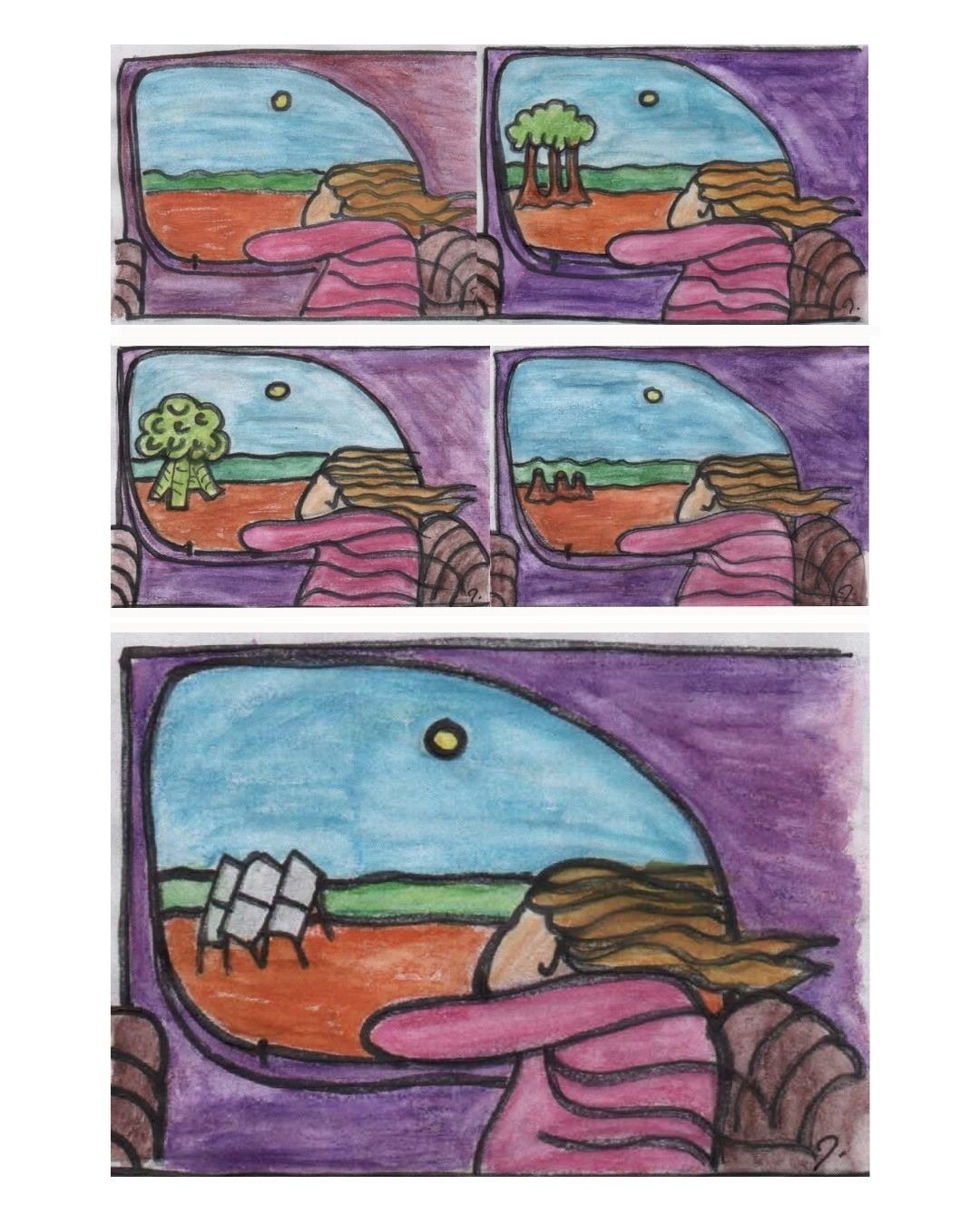
Since 2020, I’ve seen a lot of confusing and devastating news items. Among them, there are the increasingly «normalised» videos of olive and orange trees pulled out by bulldozers, to be replaced by «macro-projects» of solar panels or wind turbines in large areas of Spanish land. What an irony to eliminate thousands of trees to promote «green» energy.
.
By Ana Rivadulla Crespo
Illustrations by Pablo Rodolfo Monguillot
.
When I re-live those videos inside me, I feel a mixture of anger, helplessness and despair, which no argument can justify. These emotions seek an outlet to express themselves and I need to find my human capacity to think and to question the absurd and contradictory. But questioning, at least out loud, is a «skill» that seems to be in short supply lately in this society of increasingly artificial and programmed intelligence.
Questions open paths for me and can always lead me towards positive actions and solutions. Lately, however, I’ve felt fearful and inhibited when asking inquiring questions in certain social contexts. Do I perceive indifference or a critical gaze from my interlocutors? Faced with this fear of rejection, I seek escape through distraction, which comes in infinite disguises. Any action that causes me to step out of my deepest thoughts and emotions is distraction.
While I flee from my emotions and questions, many trees are falling and dying, and, in equal proportion, my feeling of guilt increases. This is how I feel because every dawn I wake up earlier and with more questions that I identify as my greatest human factor, as my «antidepressant» in the face of such a heartbreaking situation. Each awakening is an explosion that emerges from the unconscious of my ancestors, as if they were whispering those questions to me through my dreams. Questions which are not only not forbidden, but give me the joy of solutions and hope when I wake up every morning.
In every situation we live in, new questions open up to us, curious sighs of the soul. Where in my life did I begin to fear certain questions, and what energy replaced them? What kind of questions do I fear most, and in what contexts? Which questions do I express and which do I keep silent?
The pain and helplessness that I feel when I see the death of all those communities of exterminated trees has brought back to me the memory of my first friendship with a tree. A tree that reminds me of the questions I used to ask myself as a child, and that life in the big city only seems to set aside, harden, and compartmentalise.
“Nuestro pino” (“Our pine”). That’s what we called it. It was a typical Mediterranean pine, one of those that look like broccoli. It stood right at the entrance to a town called Valls, in the province of Tarragona. We greeted him from the car on our drives to the beach many weekends of my childhood. Greeting “our pine” became a point of reference that marked the way and the distance already close to the longed-for Mediterranean Sea. Seeing that pine tree and greeting it became something as special as seeing a loyal, omnipresent friend of supernatural strength. A focus of life that dazzled us with its beauty after an hour and a half of continuous road, which the songs in the car and the questions and conversations with my parents used to shorten. Without desire for possession, it became an internal home, of belonging to its natural and free world, a place of hope to which I could always return and find those moments of shared excitement that the aroma of any pine tree now immediately evokes.
Truth be told, that pine lives in every tree in my life, regardless of the species it is or how it came into place. Native or exotic species that have learned to coexist, as does the eternal kiss of the Mediterranean Sea and the Atlantic Ocean during their encounter at the mouth of the Guadalquivir.
Thanks to that pine, each tree has become a stoic and generous teacher who is able to give peace to my soul. This tree nourishes all who approach it; not only does it convert carbon dioxide into oxygen, but it protects us from floods, heat, wind, rain, and cold; it anchors us and gives us shelter. And from his seed, his rootedness, and upright attitude of elevation, he faithfully shows us how to walk through our lives.
Now I write accompanied by a rubber tree called Carlitos, whose roots have survived constricted in a pot for many years. Perhaps Carlitos represents something of my nomadic spirit, which continues to look to the sky and longs to expand its roots in an integrated land. On the horizon of my dreams, the pine tree feels the warm company of palm trees that rise with their slender elegance. Through the window of my immediate reality, there is the solace of fir and plane trees populated by squirrels, robins, and blackbirds. I also sense the scent of a magnolia tree in bloom. The olive trees of my beloved Spain always live in my core. Their oil has lubricated my cells since I was born. In my watercolors and journals, the carob trees and all the trees visited by the hummingbirds of my beloved Argentina coexist: the palo borrachos, the tipas, the aguaribayes, the jacarandas, the chañares, the espinillos, the red and white quebrachos and more palm trees… the Carandays!
There are so many trees I love that they couldn’t fit into this humble essay but I cannot fail to mention the cork oaks of Doñana, the walnut trees of Asturias, the holm oaks of Extremadura, the beech forests of La Rioja, and the fig trees, cherry trees, chestnut trees, almond trees, vineyards, and fruit trees that, like our rivers, ignore the boundaries of our various Spanish languages. Who knows the names and routes of these rivers—also underground—and the fate of their waters? Which swamps have contained the swaying of which rivers, and which have been destroyed or are in danger? Where are the fountains in the squares of the towns and cities of our childhood?
I haven’t passed by the Valls road for years and I haven’t seen «our pine»; but its essence lives on, not only within me, but in my relationship with all trees, even the fallen ones, those that have already turned to ash, like that of our dead. Essences at the service of life. Lives sacrificed for noble causes… for deception?
Using the wood from trees with balance and respect is not the same as removing thousands of trees, an act that constitutes an attack on the life of all nature.
We are also nature, that dance of anabolic and catabolic tides, birth and death, a natural balance. Artificial imposition eliminates nuances, simplifies, denies, and divides existence. The more dissociated we are from our nature and confuse the meaning of health and ecology, the greater the deception and confusion in our lives: feeding on nature is natural; replacing it with artificial substitutes to «protect» nature is an incongruity. To eliminate these communities of trees is to eliminate our life; to disregard our culture, to forget our literature, our poetry, our painting, to deny our questions, also the brave questions of our childhood.
What does the life of a tree mean to a child, to a human being, to all living beings that inhabit the planet? What conversations will be held by microorganisms and earthworms, bees, lizards and geckos, dragonflies, ladybirds, grasshoppers and cicadas, ants, birds, and other mammals that live underground, in the trunks and the treetops of all the forests that are being destroyed right now?
What symphonies do we miss and will we lose at every dawn, throughout each day and night? Are we willing to replace the sound and harmony of nature with the technological desert of panels and the shuddering noise of those giant wind turbines? What echoes will all this produce in our imagination?
How far does the devastation and madness go? What must be the pain of those olive trees and their roots? Do the trees have a survival strategy we do not know? Is Carmen Mestanza’s desolate cry the call to embrace all the roots they want to extirpate, whose sap warns us of the pain we will face when we feel the consequences of this extermination in a more directly, personal, and collective ways?
What does it mean to be ecological? Why do they prohibit collecting and watering gardens with rainwater? Why is it allowed to break the course of a river to cut down trees and, at the same time, destroy swamps with the excuse that the rivers flow? Has anyone ever wondered which communities will be affected by the future waters of the rivers that carry the waste of greed?
I hear the sighs of our history through Albéniz, Granados, and Falla. Suddenly, I arrive in 1975 and the song «Sé de un lugar» by the musical group Triana transports me to the land where the sun and the trees lived in a relationship of eternal love, where the presence of the tree was a sign of security, refuge, and prosperity.
What if each of us remembered a tree—one of many—that has represented something important in our lives?
When we realise that we have been deceived, what happens inside us? What do we do when we perceive an external reality that does not coincide with our principles of life?
How long will it take for those hectares of already impoverished land to detoxify and regenerate? What protection does the land have against the inevitable storms? When will it be possible to cultivate those plundered lands again? If these actions continue, from where will we get our spiritual and physical nourishment?
What part of our soul do we stop loving when indifference to the pain of others possesses us? Where does such indifference come from? Is indifference the defence of impotence? Is impotence the laziness of fear? What happens when my fear fears its paralysis more than change? Is fear the discomfort that encourages us to be brave? How much discomfort do I need to feel to become braver? How do I manifest my courage?
What does it mean to be human? What human ingredients lead us to empathise with others and to attract people capable of facing the giant Goliath? What would Cervantes write if he were alive today? How do we interpret Don Quixote? How do we decide which answer to give more value to and what influences us in that decision?
From the surreal distance of London and with the company of Carlitos, my restricted rubber tree, I continue to listen to more music that connects me with the roots of those trees, now «Orobroy» by Dorantes. I am deeply grateful to all my fellow compatriots, the voice of my ancestors, who are doing their best to protect the life that our grandparents created with so much effort so that we can now live with greater freedom, comfort, resources, and time to think. But how can I readjust in the face of so many contradictions? How can I use my time and creativity without filling it with an escapism that detaches me from the possible and positive solutions of this reality? How can we write our history so as not to be dragged down by falsehoods or programmed impositions?
Perhaps the first antidote to indifference—that entrenched fear—is to write a letter to the first tree that hosted an intimate moment in my childhood and ask it, from its deepest roots, to embrace the trees of all forests, fields, lands, and homes. And so that, from that embrace, we love life through the union of the beings that constitute it and collaborate in real, vital and noble human causes.
Ana Rivadulla Crespo
London, 14th June 2025.
(English translation on 30th March, 2026)
Read this article in SPANISH
With this playlist —inspired by the article «The Presence and Legacy of the Tree» by Ana Rivadulla Crespo—, La Tundra invites you to listen to songs that pay tribute to your tree, and to all the trees in your story and ours. Listen now
Send us your suggestions so we can add them to the playlist. And if you’d like to write a letter to «your tree,» contact us at colaboradores@latundra.com so we can publish it on our website or social media.